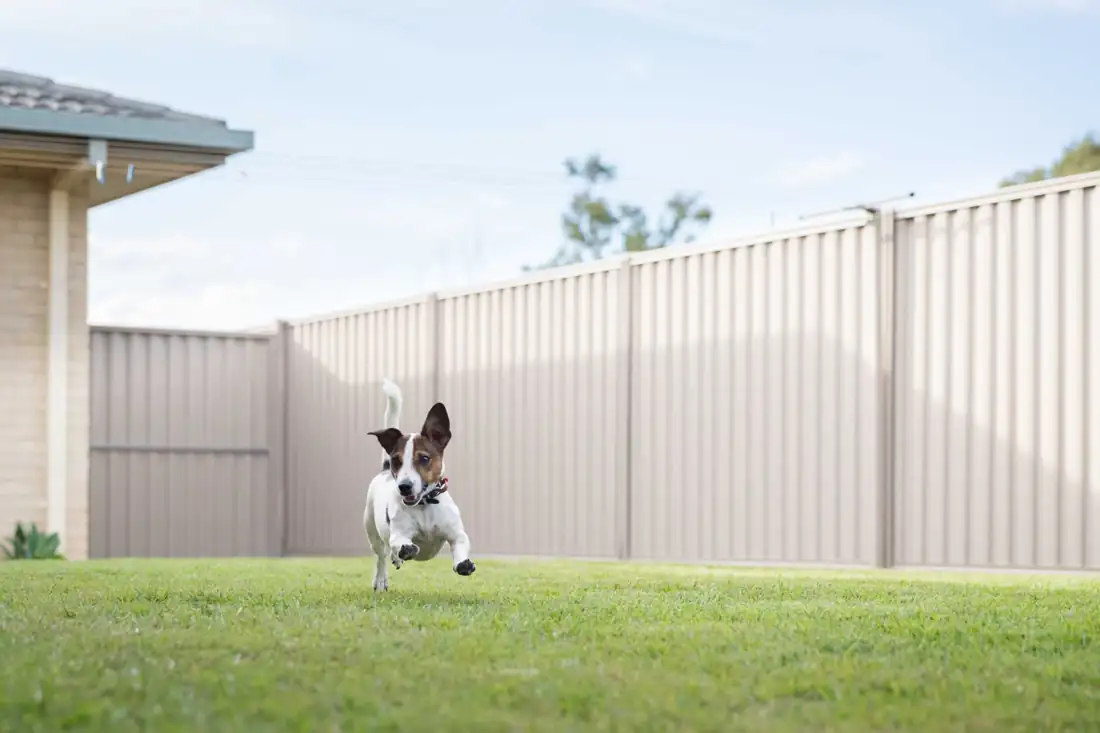
A good dog fence gives your pup room to run and gives you peace of mind. But “dog fence” means something different for a Frenchie than for a Cane Corso, and something different again for a beagle who digs or a husky who treats every fence as a puzzle. At 76 FENCE Main Line, we start by asking about your dog, not just your yard. Here’s how to think about it.
Start with your dog’s escape style
The jumper
Athletic, high-energy breeds can clear a surprisingly tall fence. Height and a smooth top with no easy footholds are your friends.
The climber
Some dogs use horizontal rails or chain link like a ladder. Designs with rails on your side, or smooth solid panels, help.
The digger
Terriers and hounds often go under. A fence set close to the ground, with a dig barrier along the base, stops tunneling.
The squeezer
Small dogs slip through gaps. Tight picket spacing, a solid privacy fence or added mesh keeps them in.
How tall should a dog fence be?
There’s no single number, but here’s a practical rule: small, calm dogs are often fine with a 4-foot fence, while medium to large dogs and athletic breeds usually do better with 5 or 6 feet. If your dog has already cleared a fence somewhere else, go taller. Keep in mind that height limits vary by township and HOA, and front-yard limits are often lower than backyard limits. Rules vary; we check them for you before we design your fence.
The best materials for dogs
Vinyl privacy
Vinyl is a favorite with dog owners. Solid panels block the view of passing squirrels, joggers and other dogs, which can cut down on barking and fence-running. The smooth surface is hard to climb and can’t be chewed like wood, and it’s easy to hose off.
Wood privacy
A solid wood privacy fence also blocks sightlines and is a natural look for many Main Line yards. Just watch for chewers, and keep the horizontal rails on the side away from your dog so they can’t be used as a ladder.
Aluminum
Aluminum keeps an open view and looks elegant, and it works well for many dogs. Ask about puppy pickets, which add extra pickets along the bottom so small dogs can’t slip through the gaps.
Chain link
Chain link is strong and budget-friendly, and black vinyl-coated chain link blends into landscaping. It’s a good fit for many dogs, but determined climbers may use the mesh as a ladder, so it’s better for dogs that don’t climb.
Don’t forget the gate
More dogs escape through gates than over fences. A gate left ajar by a delivery driver, or one that doesn’t latch fully, is all it takes. For dog owners we recommend:
- Self-closing hinges so the gate swings shut on its own.
- A latch that catches reliably every time.
- A lockable latch if service workers use the gate.
- Minimal gap under the gate, especially for small dogs.
- Sturdy gate posts that won’t sag, so the latch keeps lining up.
See our gates page for options.
Stopping diggers
For dogs that dig, the key is what happens at ground level. We keep the bottom of the fence close to the grade, and on sloped yards we plan panel steps so there are no triangular gaps underneath. For persistent diggers, a buried wire or mesh barrier along the base can help. Main Line yards often have clay-heavy soil that’s easy for some dogs to dig in once it’s wet, so it’s worth planning for.
Fences and invisible dog systems
If you have an underground electronic pet fence, let us know before installation. Those wires are private lines, and the PA One Call (811) locate doesn’t mark them. Many homeowners choose a physical fence because it also keeps other animals out, which an invisible system can’t do.
If your fence also surrounds a pool, it needs to meet pool barrier rules: at least 48 inches high, with self-closing, self-latching gates that open outward away from the pool. Your township inspector has final say. See our pool fences page.
Ready for a fence you'll love?
Book a free, no-pressure estimate. Zero dispatch fees — and we handle permits, HOA paperwork and the 811 call.
Get a fence built around your dog
Every dog is different, and so is every yard. During your free estimate we’ll ask how your dog behaves, look at your slopes and gates, and recommend a height, material and gate setup that works. Explore our pet fences page, compare wood vs. vinyl, or book your free estimate. You can also call or text 484-779-6307.